

PSYCHEDELIC-ASSISTED THERAPY INTENSIVES IN Long Beach, CA
FOR THE THINGS YOU UNDERSTAND, AND THE THINGS YOU CAN’T QUITE ACCESS.
Trauma doesn’t always come with a clear story. Sometimes you understand exactly what happened and still feel it living in your body. Other times, you can sense that something is there through a feeling, a reaction, a pattern, or a knowing you can’t quite put into words.
Some experiences live deeper than language, and beyond what we can easily access in our ordinary state of consciousness.
These extended, trauma-focused intensives combine heart-centered expanded states of consciousness with Somatic Experiencing® nervous system regulation techniques, creating an opportunity to approach emotions, protective patterns, memories, and experiences held in the body while supported by a greater sense of safety.
This work is designed for people who have already spent time in therapy, understand themselves deeply, and are ready for a more experiential, embodied approach to healing.
An alternative, non-traditional approach
to TRAUMA-FOCUSED therapy
Why are people are turning to Psychedelics?

01
ACCESS WHAT’S HARD TO REACH
Our protective systems are incredibly good at keeping us away from emotions, memories, and sensations that once felt too overwhelming to fully process. Altered states can create expanded emotional access, allowing us to approach familiar material from a different place.

02
EXPERIENCE YOURSELF DIFFERENTLY
For some, that means deeper connection to the body, increased self-compassion, or a heart-opening experience. For others, non-ordinary states of consciousness can support a new understanding of self, traumatic experiences, and pain they’ve been carrying.

03
WORK WITH WHAT EMERGES
When psychedelic states are combined with modalities that support nervous regulation like Somatic Experiencing®, you can work experientially with what arises in the body and close the trauma loop. Somatic processing gives us an opportunity to experience something different within it.

A Psychedelic-Assisted therapy intensive CAN BE A STANDALONE EXPERIENCE, OR PART OF our ONGOING work.
You don’t have to become a weekly therapy client to do a psychedelic-assisted therapy intensive. This work can be structured as a standalone experience or incorporated into ongoing individual therapy as part of a longer arc of trauma-focused work.

HOW DOES a SOMATIC PSYCHEDELIC-ASSISTED THERAPY intensive WORK?
Psychedelic-assisted therapy with a somatic trauma therapist is more than the expanded-state experience itself. Our work unfolds through a three-step process:
-
Before entering into an altered-state, we’ll spend dedicated time understanding your history, clarifying your intentions, getting to know your nervous system patterns, developing resources, and preparing you for the experience ahead.
The goal of these sessions is to answer any questions you have about the experience, create enough safety, trust, and orientation that you can meet what does.
-
Our extended session gives us the time and space to enter an altered state, follow your intentions, and stay with what emerges without rushing the process.
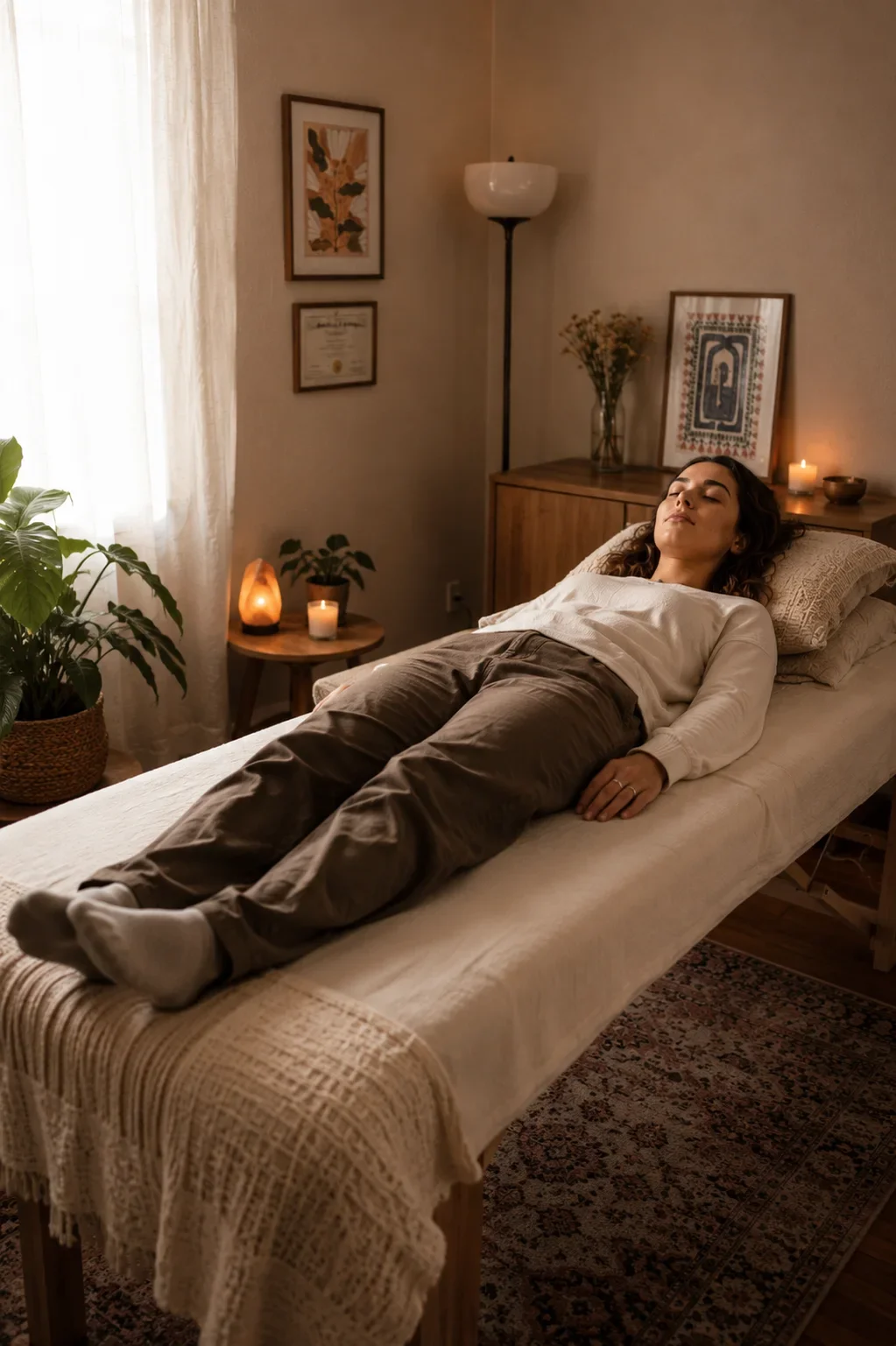
You’ll be comfortably supported on a bodywork table throughout the experience, allowing your attention to turn inward and your body to fully settle into the work.
Rather than directing where the experience should go, I use Somatic Experiencing and nervous system tracking to follow your body’s cues, support a sense of safety and connection, and help you stay with what naturally emerges. Depending on what arises, therapeutic touch and body-based trauma processing may also be incorporated into the work.
-
Integration sessions give us dedicated space to process the experience, make meaning of what emerged, connect insights and experiences back to your everyday life, continue somatic processing where needed, and discuss action-oriented ways to translate the experience into meaningful change.
Integration is where the altered-state experience becomes part of your everyday waking life.
-
Preparation Sessions: $250
Experiential Session: $850
Integration Sessions: $250
The number of preparation and integration sessions will vary based on your personal history, nervous system, prior experience with psychedelics, and the work we’re doing together. Most clients complete 2–3 preparation sessions and 2–3 integration sessions for their first experiential session.
For clients who choose to continue with additional experiential sessions: preparation is typically reduced to 1–2 sessions, as we’ve already established a foundation and familiarity with the process.
Additional preparation or integration sessions may be recommended depending on your history, experience, and individual needs.

Client Experiences With Psychedelic-Assisted Therapy
“I feel like I’m beginning to reclaim who I am in a really big way. I’m beginning to see that this is who I am, and I’m okay. I’ve never felt that way before, like I was enough. I grew up without ever feeling safe or protected, and now I think I can feel that way for myself. I’m not sure I could have gotten here without the psychedelic work. I think I needed that kick to get through the door.”
“The psychedelic ceremony helped me see that I always thought I was just somebody who didn’t have strong feelings about things. But I think I was just somebody who didn’t want to admit to having strong feelings about things. I can’t believe how much I was carrying around that I wasn’t able to express at the time, but now there is this great kind of letting go feeling. All that weird heaviness... it’s gone. I feel so free.”
“I’m not sure I could have done this level of work without the psychedelics. I was so good at repressing things. The psychedelic work jumpstarted something major and now there’s no going back. There’s only forward. I’m really starting to genuinely feel things, and I can already tell that I’m different… just three weeks out of the experience. People are noticing positive changes in me too. It’s unbelievable, this work.”
Frequently Asked Questions
-
Not at all. Previous psychedelic experience isn’t required. I do, however, ask that you have prior experience with therapy, somatic work, or another form of nervous system-focused healing before beginning this work. We’ll spend time in preparation making sure you feel oriented to the process and have resources to support whatever may arise.
-
That’s completely okay. Preparation is an important part of the process, particularly if altered states are new to you. We’ll talk through what you might experience, your questions and concerns, how we’ll work together, and what will help you feel supported going into the session.
-
This work can be particularly compelling for people who have already spent time in therapy or personal healing work and feel there are places they still can’t quite reach. You may understand your patterns intellectually but continue to feel them in your body, or sense that certain emotions, memories, or experiences feel too distant or overwhelming to approach in an ordinary state of consciousness.
-
No. Psychedelic-assisted therapy requires thoughtful screening and isn’t appropriate for everyone.
As a matter of my own scope of practice and training, I do not offer this work to clients with a history of substance use disorder or a diagnosed mood or personality disorder. Certain personal or family psychiatric histories, medical conditions, medications, and other factors may also affect whether altered-state work is appropriate.
We’ll review your history, current medications, prior therapeutic experience, and overall readiness during the consultation and preparation process.
-
Experiential sessions are typically scheduled for 3–5 hours, giving us plenty of time for the altered-state experience itself, therapeutic processing, and a gradual return to ordinary awareness without rushing.
-
There isn’t one universal altered-state experience. You may notice shifts in your perception, emotions, body sensations, sense of time, internal imagery, or relationship to yourself and your memories. Some experiences feel deeply emotional or heart-opening, while others may feel quiet, embodied, reflective, or transpersonal.
There is no particular experience you’re supposed to have. The work is about staying curious about what emerges and allowing your experience to unfold without forcing it in a particular direction.
-
Yes. You remain conscious throughout the experience and can communicate with me as needed. At times you may naturally become quieter or more internally focused, and at other times there may be conversation or more active therapeutic processing.
-
Difficult material can emerge during altered-state work, which is one reason preparation and therapeutic support are so important. Rather than pushing through activation, I use Somatic Experiencing® and nervous system tracking to help us slow things down, notice what your body is communicating, and work with the material in manageable pieces.
-
No. Therapeutic touch is never required and is always consent-based. During preparation, we’ll talk extensively about what therapeutic touch can look like, including the areas of the body where I may offer touch and what feels comfortable or supportive to you.
Consent is ongoing. I’ll ask again on the day of your session and throughout the experience, and I’ll tell you where I intend to place my hand before making contact and when I’m going to remove it. You can change your mind or decline touch at any point.
-
Potentially. I work with clients who are already seeing another therapist on a case-by-case basis. When appropriate, we’ll discuss how this work fits within your existing therapy and whether coordination with your current therapist would be helpful.
-
Absolutely. Psychedelic-assisted therapy can be incorporated into a longer arc of ongoing trauma-focused and somatic therapy rather than experienced as a standalone intensive. Current ongoing therapy clients also receive a reduced rate for the experiential session.
-
The number varies based on your history, nervous system, prior psychedelic experience, and the work we’re doing together. Most clients complete 2–3 preparation sessions and 2–3 integration sessions for their first experiential session.
If you continue with additional experiential sessions, preparation is typically reduced to 1–2 sessions because we’ve already established a foundation and familiarity with the process. Additional preparation or integration may be recommended when clinically appropriate.
-
Experiential sessions take place in person in Long Beach, California. Because you should not drive after an altered-state session, you’ll need to arrange transportation home, such as being dropped off and picked up by someone you trust.
We’ll discuss transportation and day-of logistics during preparation so you have a clear plan in place before your session.
-
No. Psychedelic-assisted therapy intensives are offered on a private-pay basis and are not billed directly to insurance.

TRUE HEALING HAPPENS WHEN WE MOVE FROM TALKING ABOUT THE THING TO ACTUALLY FEELING IT. PSYCHEDELICS HELP US DO THAT.
There are things we can understand for years and still carry in our bodies. With the right support and a sense of safety, expanded states of consciousness can create space to access what’s been buried, meet old pain differently, and stay with what emerges with greater curiosity, compassion, and ease.
About Clara Mackinlay,
psychedelic-assisted therapist

My work sits at the intersection of trauma therapy, somatic healing and altered states of consciousness. I’m a somatic trauma therapist with specialized training in Somatic Experiencing®, EMDR, psychedelic-assisted therapy, preparation and integration, and therapeutic touch. I’m also a former yoga teacher and a Reiki Master. My clinical work is deeply body-based, with particular attention to the nervous system, attachment, protective responses, and the ways traumatic experiences can continue living in us long after we understand them intellectually.
My relationship with this work is also deeply personal. Psychedelics and plant medicines have been an important part of my own healing journey, and my understanding of expanded states of consciousness has been shaped not only by Western clinical training, but by years of personal experience, more ceremonies than I can count, consistent mentorship, and continued learning from Indigenous and earth-based traditions.
As the daughter of Argentinian immigrants and someone of Indigenous South American ancestry, I feel a personal connection to the lineages from which many of these practices and principles emerge. I approach them with deep reverence, while remaining thoughtful about the distinction between Indigenous ceremonial traditions and the clinical work I offer as a therapist.
What I bring into the room is a merging of worlds: trauma-focused clinical training, advanced education and training in nervous system work, therapeutic touch, lived experience with various altered states, reverence for shamanic traditions, and deep respect for the wisdom of the body. My role isn’t to determine where your experience should take you. It’s to create enough safety, attunement, and support for you to follow what emerges.